


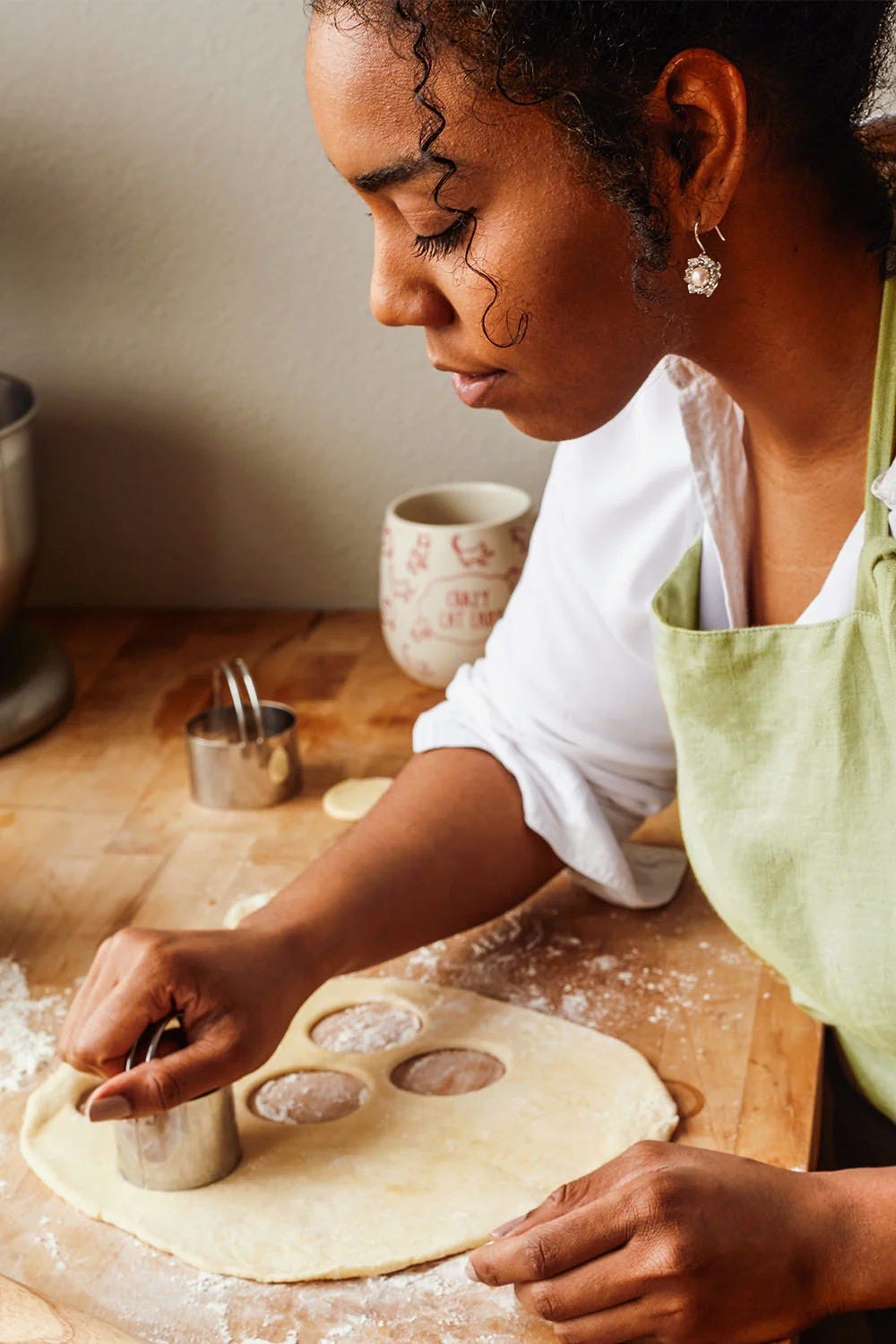
I first met Jerrelle Guy five years ago, when I was an editor at another publication, and one of the first things that drew me to her was learning that she is a RISD alum, like my son. From the beginning, there was synergy. Over the years, we’ve stayed connected in a way that flowed and never felt forced. Whenever she’s in New York, she makes a point of coming into New Jersey just to say hello, which tells you a lot about who she is. From Black Girl Baking to her Anthropologie dinnerware collection to We Fancy, she has created a body of work shaped by culture, style, and a sensibility that is entirely her own.
At the heart of this conversation is the truth that food can feed more than our appetite. For Jerrelle, it became a way to make sense of change, follow nostalgia, and trust what felt instinctive before there were words for it. Food offered more than comfort. It offered direction. It offered a way back to herself. In that sense, food becomes a metaphor here, not only for nourishment, but for setting the kind of table you want to see in the world. A table where history is passed, culture stays in motion, taste becomes language, and what is made by hand shapes how people feel, see themselves, and find one another. That is what gives the conversation its depth. It may begin with food, but it points to something larger — how we feed thought, make room for others, and create something that nourishes more than ourselves.
At Your Table: What is something food has helped you remember?
What the Kitchen Held First
ART: Your work often feels as much about feeling as it does about food. At what point did the kitchen become a place where creativity, memory, and identity all began to live together for you?
JG: Everything seemed to click when I moved to Boston. I felt like a fish out of water in some ways because I was only 24, living in a new city, starting grad school where I knew no one, and there were almost no people of color in my classes. I was searching for meaning, and food was the easiest and most obvious place to find that. It became a way to reflect on my life up until that moment and anchor myself in some feeling of home.
ART: Before the books and the wider audience, there was simply you learning your way through the kitchen. What shaped your instincts the most in those early years?
JG: My nostalgia, my craving for comfort, and whatever was in my pantry were the main influences. I think the more ingredients I had to choose from, the more creative and expressive I felt. But no matter how experimental I got, there always seemed to be a certain essence in the food that pointed back to my identity.
ART: Food carries memory in a way very few things do. Is there a dish or flavor that instantly takes you back to a particular kitchen or moment in your life?
JG: There are so many. Right now I’m thinking of Spaghetti Red. It’s a Southern dish that I can never find anywhere, so I usually have to make it at home, or have family make it for me, if I want it made “right.” It’s basically spaghetti noodles in a sweeter-than-normal red sauce, and the version I love has green bell peppers cooked in, with little pieces peeking through the sauce. The noodles are cooked past al dente, which is important, so they break into shorter strands. We serve it at family gatherings, usually with fried catfish. I remember it being served at my Madea’s funeral in Mississippi when I was about 10 or 11, and I ended up requesting it for my wedding reception, where the theme was a Florida fish fry.
Instinct, Not Instruction
ART: Your cooking often feels intuitive rather than rigid. At what point did you begin trusting your instincts in the kitchen rather than relying strictly on rules?
JG: All the adults around me cooked this way. No one followed recipes or cookbooks. Everything was intuitive, by memory, or by word of mouth.
ART: Every cook has a small ritual or habit in the kitchen that never makes it into recipes. Do you have one that always shows up when you’re cooking?
JG: I’m a little weirdo who is always getting lost in my senses whenever I’m baking or cooking. That was pretty obvious in Black Girl Baking. It can seem overboard to some, but my senses are super heightened. In the kitchen, colors seem very vibrant, textures are tantalizing, and smells are intense, and I get to experience all of that in one space. I love getting lost in it because, in some ways, it slows down time. It almost feels like its own portal.
ART: Baking often asks for precision, while the way you talk about cooking now feels much more intuitive and free. How do those two sides of the kitchen coexist in your practice today?
JG: Honestly, I can’t tell if I’m sad about learning more technical forms of recipe writing or not. Something feels really stiff and stern in my thinking now, to the point that I almost lose the joy in sharing a written recipe. I still have an old editor in my head nitpicking, and I want to free myself of that voice so I can return to recipe development as something relaxing, joyful, and fluid. That was a big part of what I was trying to achieve in We Fancy, too.
ART: Your new book, We Fancy, speaks to the idea that “fancy” is less about luxury and more about intention. Was there a moment when that shift in perspective really clicked for you?
JG: Pretty early on. I knew I wanted to go in that direction before I signed the book deal, but the meaning of the word grew more layered as my personal philosophy on life started seeping into the book. I couldn’t help it, so I embraced it and went all in.
ART: Your first book, Black Girl Baking, was rooted in desserts and personal storytelling. With We Fancy, the lens widens. When you think about the time between the two books, how has your relationship with cooking evolved?
JG: It’s gone through its own hero’s journey. I think I lost myself between the two books, trying to expand my career by developing too many recipes for different media outlets, thinking too much about trends and what might sell best to a particular audience, and also cooking and eating the recipes from the cookbooks we were photographing. It all made me lose direction, and it drained some of the spark from my personal practice of cooking because by the end of those busy days, there was no time to eat what I actually felt inspired to make. Thankfully, I’ve come back to myself and my own way and process with this latest book.
ART: For someone who hopes to write a book one day, what’s something you’ve learned through the process that might help them approach that journey with a little more clarity or confidence?
JG: You can never plan too much, and you can never take too many notes. Also, what you think it will be in the beginning will probably change dramatically by the time it’s finished, but let that unfolding delight you.
At Your Table: Where in your life are you being asked to trust your own instincts again?
What the Recipe Can’t Teach
ART: The internet moves quickly, but cooking asks us to stay with the process. How do you maintain that relationship with time and patience in a culture that often rewards speed?
JG: I fight hard internally not to let the noise and the trends pull me too far from what I personally want to create and eat anymore, and usually that just looks like not being on social media too much. I noticed how my earlier days on Instagram really shaped my diet and my life in ways that stopped feeling authentic to me.
ART: Food has always been tied to culture, identity, and storytelling. When did you begin to understand the deeper narratives that live inside the recipes you create?
JG: Definitely in grad school, specifically in Anthropology. We learned about cultures through their rituals around food, and when I started seeing certain threads that led back to my own culture and heritage, I was fascinated.
ART: When you look at the way people cook today, especially in a digital world where recipes travel quickly, what do you hope we don’t lose about the experience of being in the kitchen?
JG: Artistic license. I think there’s a current rhetoric around recipes that says they should solve all our problems and rescue us from the experience of cooking as much as possible, and that if they don’t, they’re somehow inferior. But historically, recipes were always rough notes. Even your grandmother’s recipe cards were chicken scratch, not really meant to walk you seamlessly from point A to point B. There was so much hidden in the margins that you had to interpret, imagine, and learn through experience.
The pressure we now put on modern recipes to hold our hand through every single step gives the recipe too much of our personal power. It can take away our artistic license, dull our imagination and intuition, and drain the joy of making something uniquely ours. It’s nice to know the science of how something works, but cooking is so personal. Recipes are not prescriptions. They’re more like scribbles of advice on paper. Take what resonates, what feels inspiring to you, and discard the rest.
The TBOYaficionado Lens
ART: At TBOYaficionado, I’m always drawn to things that feel timeless, unfussy, and full of character. From We Fancy, is there a recipe that captures that spirit for you—something elevated, but still rooted in everyday living?
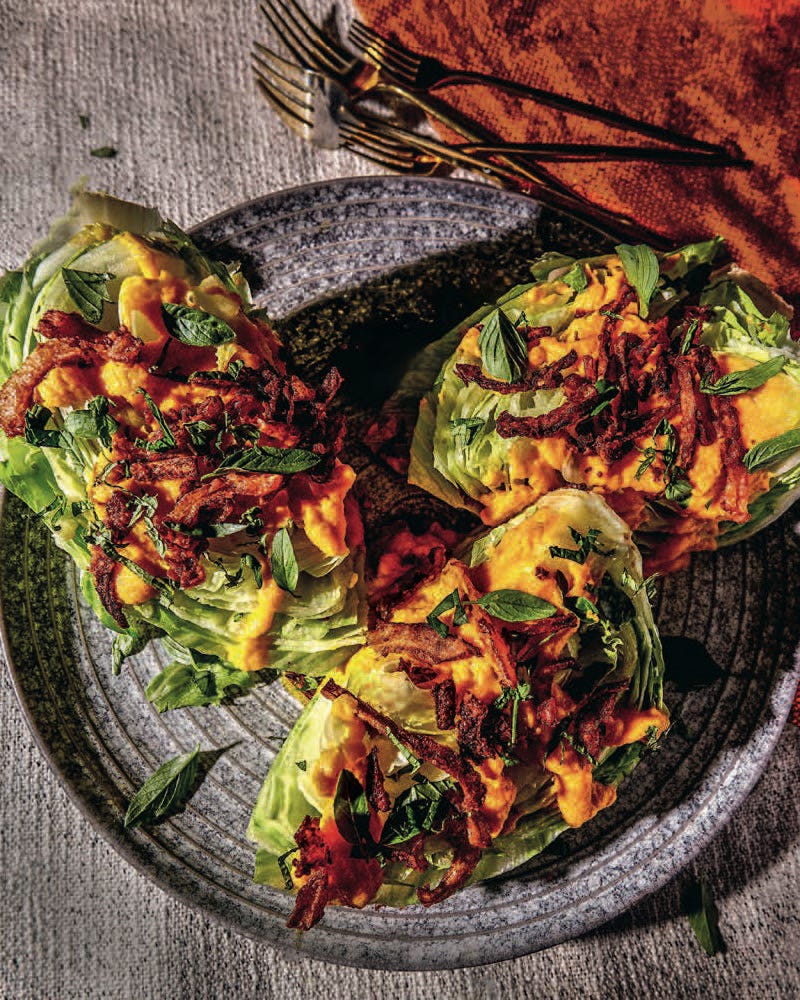
Carrot & Miso Wedge Salad
Ingredients
1 large carrot, peeled and chopped into chunks
1 1½-inch piece fresh ginger, peeled
½ cup unsweetened applesauce, or 1 small pear, halved and cored
2 tablespoons rice wine vinegar
2 teaspoons white miso paste
1 tablespoon lime juice, from 1 lime
¼ teaspoon toasted sesame oil
½ teaspoon kosher salt
⅛ teaspoon white pepper or freshly ground black pepper
1 tablespoon sake, optional
2 tablespoons avocado oil or olive oil
1 head iceberg lettuce, quartered through the core and trimmed
Frazzled Onions, for topping
Make it fancy
Add a confetti of Thai basil to the wedges for a poppy, anise-like depth or mint for a cooling bite.
Make the dressing
In a high-powered blender, combine the carrot, ginger, applesauce, vinegar, miso paste, lime juice, sesame oil, salt, pepper, sake if using, 2 tablespoons water, and the oil. Blend on high until the sauce is completely smooth and has a creamy golden-orange hue.
Build the salads
Place each iceberg quarter on serving plates and generously spoon the dressing over. Top with Frazzled Onions and serve.
Excerpted from WE FANCY. Copyright © 2026 by Jerrelle Guy. Reproduced by permission of Simon Element, an imprint of Simon & Schuster. All rights reserved.
What Remains
ART: When people welcome your recipes into their kitchens, they’re also welcoming a piece of your story. What do you hope stays with them long after the meal is finished?
JG: When they step into the kitchen to make whatever it is they’re going to eat, I want them to remember that being “fancy” with it is always an option on the table. There is always an alternative, feel-good perspective and approach that can free their minds from the daily grind.
At Your Table: What are you creating that could nourish more than just yourself?
What’s Pulling Her Forward
ART: When you look ahead, what feels most exciting for you right now, whether in the kitchen or beyond it?
JG: Learning. I’m taking all these new online classes, some in art history and some in philosophy and theology. I’m really passionate about learning new ways of seeing the world that can support my path, open up the way I see life, and inform my work.
What Sustains Us
By the end of this conversation, what feels most clear is that this was never only about food. In Jerrelle’s hands, it becomes a vessel for identity, ritual, imagination, and the ways we learn to meet ourselves more honestly. What begins in the kitchen reaches into something much larger — the understanding that what we feed ourselves, internally and externally, shapes how we live, how we move through the world, and who we become within it. What emerges here is not simply how to cook, but how to live with greater intention around what nourishes, what drains, and the kind of life our daily choices are shaping.
Allie! Thank you for sharing this thoughtful piece on my journey so far. It's a testament to your ability to hold people and see them clearly so they feel safe enough to open. I'm grateful for our friendship and I'm excited for the incredible space you're cultivating here. <3